John Smith Sr. was likely born about 1730.1 He was a Loyalist associated with Sussex County, New Jersey, during the American Revolution, and he died in New Brunswick, Canada sometime before 3 March 1797.2 The name of his wife has not yet been identified.
This is the first post in a series about this family. It introduces John Smith Sr., the children who can be identified from the surviving records, and the evidence connecting them across New Jersey and Upper Canada. A later post will examine the military evidence in detail, and another will address the several men named John Smith in Sussex County.
At least six of his children can be reconstructed from records created in New Jersey and Upper Canada: Eleanor, John, Mary, Elizabeth, David, and Cornelia Smith. Several Upper Canada land petitions identify him as John Smith, deceased, a U.E. Loyalist; some add that he served in the Jersey Volunteers or died in New Brunswick. Later probate and land records connect the children to one another and extend the family into another generation.3
Before members of the family began moving to Upper Canada, their documented home was Sussex County, New Jersey, probably in or near Oxford Township. Eleanor’s first husband, David Young, died there in 1780, and his probate record identifies him as a resident of Oxford Township. The younger children David and Cornelia Smith were still in Sussex County when they married there in 1796 and 1798, respectively.4
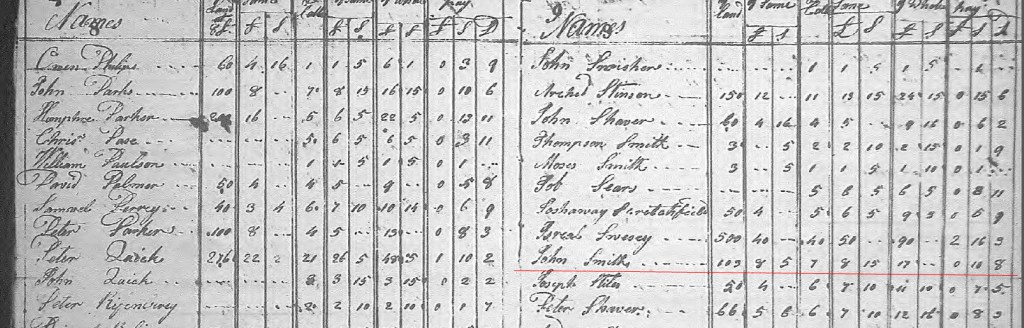
A John Smith appears in the 1773 tax ratables for Oxford Township, alongside Thompson Smith, Peter Smith, Moses Smith, and Christopher Smith. The other John Smiths in the surviving Sussex County ratables of that period were assessed in Montague and Knowlton townships.5
The Children of John Smith Sr.
Eleanor Smith
Eleanor Smith was born about 1758.6 She married David Young of Oxford Township, Sussex County, New Jersey. After David’s death, she married Robert Thompson before 1797.7
David Young died intestate by 1780; his estate was inventoried in Oxford Township on 31 August 1780.8
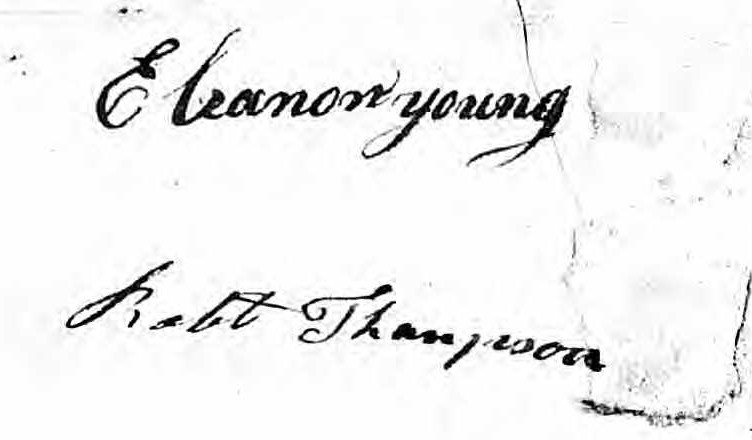
In March 1797, Eleanor petitioned the government of Upper Canada for land. Her petition material identified her as Eleanor Smith, daughter of John Smith, and described her as formerly the wife of David Young and the current wife of Robert Thompson. Supporting evidence stated that her father had joined the Royal Standard and had died in New Brunswick.9
No children were named in David Young’s probate papers; however, Eleanor and David appear to have had at least one child, a son named David, who later appears in records in Ontario, Canada.10
A 4 September 1830 petition from inhabitants of Pelham Township describes David Young as a long-standing, industrious resident who had been clearing and improving Lot 5 in the Seventh Concession since 1824. Joseph C. Price and John Smith were among the men who signed in his support. The petition does not identify David Young’s parents, and the identity of the John Smith who signed is not independently established; it is nevertheless the one located Ontario record that places David Young within the Smith–Price friends, associates, and neighbors (FAN) network.11
Eleanor and Robert Thompson later had at least seven children: James, John, Jane, Andrew Heron, Alexander Garner, Ann, and Robert Jr. Eleanor appears to have died before 17 October 1822, the date of Robert’s will. She is not named in it, although the will carefully names the children and makes provisions for unmarried women in the household.12
Robert’s will names his eldest son James; his second son John; his sons Robert and Andrew Heron Thompson; his son Alexander Garner Thompson; and his daughters Jane McClelland and Ann Thompson. It also mentions Catharine London in a provision allowing her and Ann to use a room in the house while they remained single, but the text does not clearly identify Catharine as Robert’s daughter, so she is not included in the seven-child count.13
The distinctive name Alexander Garner may have honored Eleanor’s brother-in-law, Alexander Garner/Gardiner, the husband of her sister Mary Smith.14
John Smith Jr.
John Smith Jr. was born about 1760 and died between 22 August 1844 and 24 January 1845 in Pelham Township, Welland County, Canada West.15
On 2 January 1804, while living in Gainsborough Township, he petitioned the government of Upper Canada for land. He said that he had served in the Jersey Volunteers during the American Revolution and that his deceased father, also John Smith, was a U.E. Loyalist who likewise served in the Jersey Volunteers. At that time, John had a wife and six children; his wife’s name has not yet been identified.16
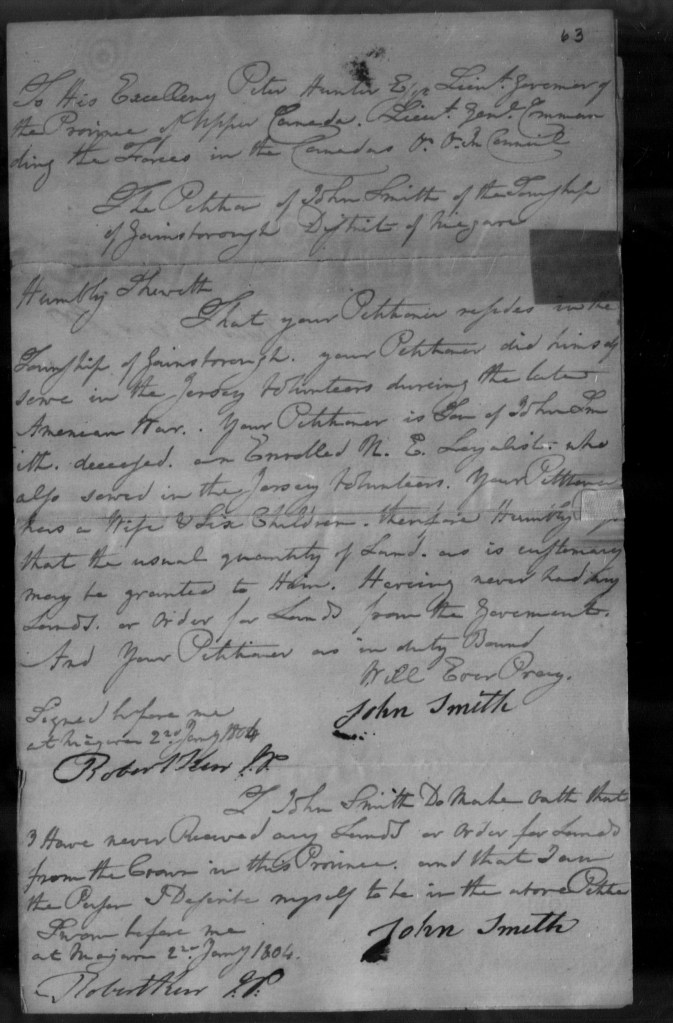
Later records clarify his position in this family. His sister Mary Smith Gardner’s land descended to a nephew identified as the eldest son and heir at law of her deceased eldest brother, John Smith of Pelham Township.17 John’s 1844 will styles him “John Smith Senr.” and names his eldest son John. The later use of Senior is compatible with a man called Junior earlier in life who eventually had an adult son of the same name.18
The petition was rejected. An annotation reveals the same identity problem faced by researchers today: “The Name John Smith of the Home District appears Three times on the U.E. List.” The name alone was not enough.19
The UE list actually yields four relevant entries when the man separately styled John Smith, Senr. is included. The annotation appears to have counted only the three entries recorded under the exact name John Smith.
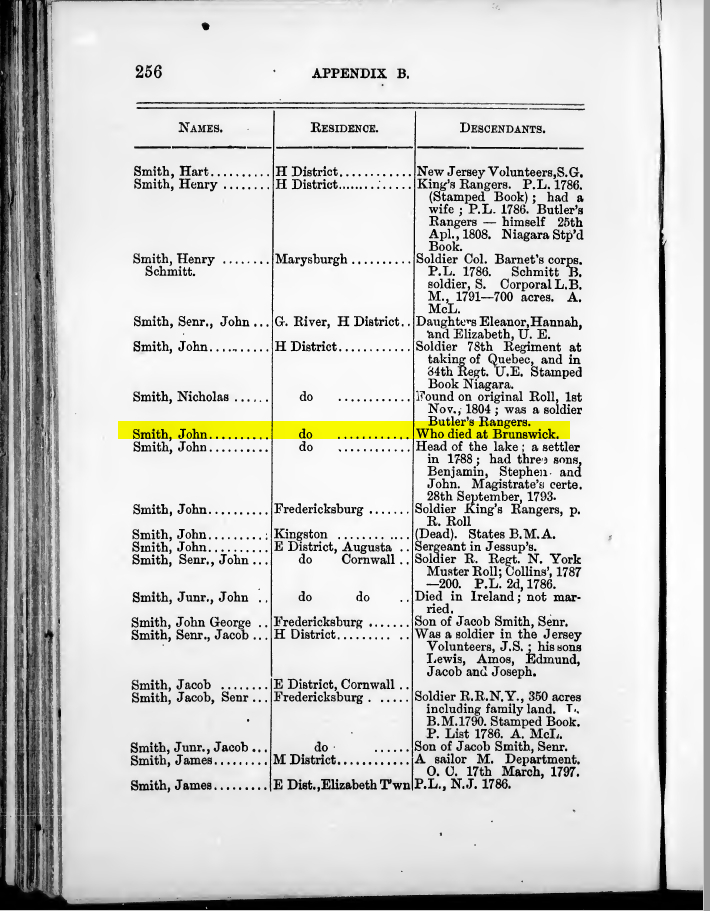
This same-name problem makes it necessary to compare the men rather than assume that any one U.E.-list entry belonged to the Oxford family.20
| U.E.-list entry | Identifying evidence | Why it does or does not fit |
|---|---|---|
| John Smith “who died at Brunswick”21 | U.E. entry associated with New Jersey and 1777. Eleanor’s petition identifies her father as a Loyalist who died in New Brunswick; Mary’s petition and the certificate annexed to Elizabeth’s describe him as deceased without naming a place; John Jr. stated that both he and his deceased father served in the Jersey Volunteers. | Best fit for the elder Oxford/Sussex John Smith and the father of the reconstructed Gainsborough–Pelham family. |
| John Smith, Senr., of Grand River22 | Formerly of Dutchess County, New York; came in 1786 with a wife and nine children. His petitions name sons William, John, and Joseph and daughters Eleanor, Hannah, Elizabeth, Lydia, and Anna. | A separate large family. It cannot be the Oxford father, who was deceased by March 1797 and reportedly died in New Brunswick. |
| John Smith of Niagara; 78th and 84th Regiments23 | Reported service with the 78th Regiment at Quebec and later with the 84th Regiment; associated with Niagara. | His regimental history does not match the Jersey Volunteers service claimed by John Jr. for himself and his father. |
| John Smith of the Head of the Lake24 | The Grimsby Lot 16–Ancaster settler who said in 1793 that he arrived in 1788; his petition names sons Benjamin, Stephen, and John. Descendant accounts call him “Little John” and identify his wife as Anna Roy. | His Canadian land history is distinct from both the Oxford family and John Smith, cooper, on adjoining Grimsby Lot 17. His alleged Sussex County origin remains unproved. |
The four entries therefore cannot be treated as interchangeable appearances of the same name. Only the “died at Brunswick” entry agrees with the father’s reported place of death, while the Gainsborough–Pelham petitioner uniquely combines Jersey Volunteers service with a deceased father of the same name who also served. The New Jersey senior–junior evidence, Oxford network, and petitions of the children complete a family pattern not reproduced by the other U.E.-list candidates.
John Smith Jr.’s 1804 petition stated that he had a wife and six children. Four of those children can presently be identified with varying degrees of confidence. John and James are directly named as sons in John Jr.’s 1844 will. Mary and Anna are not named directly as John’s daughters; their identifications rest on cumulative family-network and household evidence.25
- Mary Smith, born about 1787;26 married Joseph Carter Price before about 1807;27 died 4 January 1862 at Fonthill, Welland County, Canada West.28
- John Smith, born about 1794;29 married Catharine Schram, daughter of John Schram of Pelham, by July 1819;30 died 9 January 1863 in Pelham Township.31
- James Snyder Smith, born about 1795; he may have had a son named William or Willson, born about 1839, although that identification remains tentative.32
- Anna Smith, born about 1800;33 married a George Clark of Thorold and was later known as Anna Clark.34 She had at least three sons identified in the surviving records: John Clark, Richard Clark, and Nelson Clark—and possibly one daughter, Christeen.
Mary Smith’s identification is circumstantial, but the evidence forms a substantial family pattern. Her husband, Joseph C. Price, appears in several records with John Smith, and their sons included John Smith Price and David Smith Price. The 1862 probate of Mary Price the Elder identifies David Smith Price and Mary Price the younger as her children. A related 1868 land record identifies John Smith Price as Mary Price the Elder’s son and names his brothers and sisters; it also states that he died intestate without surviving children. These records establish the Price family structure directly, but no located record states that Mary Smith Price was John Smith Jr.’s daughter. I nevertheless believe that she was, based on the cumulative evidence.35
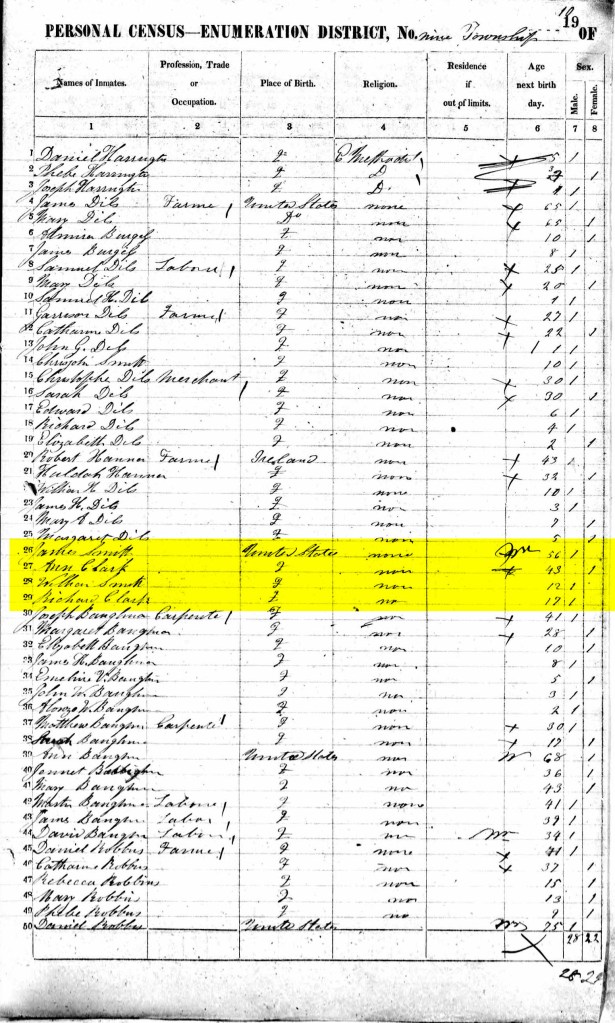
Anna’s identification rests on a particularly meaningful household connection. In the 1851 census of Gainsborough Township, James Smith was enumerated in the same household as Ann Clark, William Smith, and Richard Clark. The enumerator recorded James as a widower, as blind, and as born in the United States; Ann is recorded as born in Canada. A blind widower in his fifties sharing a house with a widowed sister and her nearly grown son is an arrangement families made, and the surnames, the birthplaces, and the composition of the household together support identifying James Smith as James Snyder Smith and Ann Clark as Anna Smith, after her marriage to George Clark. Richard Clark’s presence is consistent with his being Anna’s son. The census does not state that James and Ann were siblings, and its entries for Ann’s age and marital status are demonstrably wrong, so this remains circumstantial evidence rather than direct proof.36
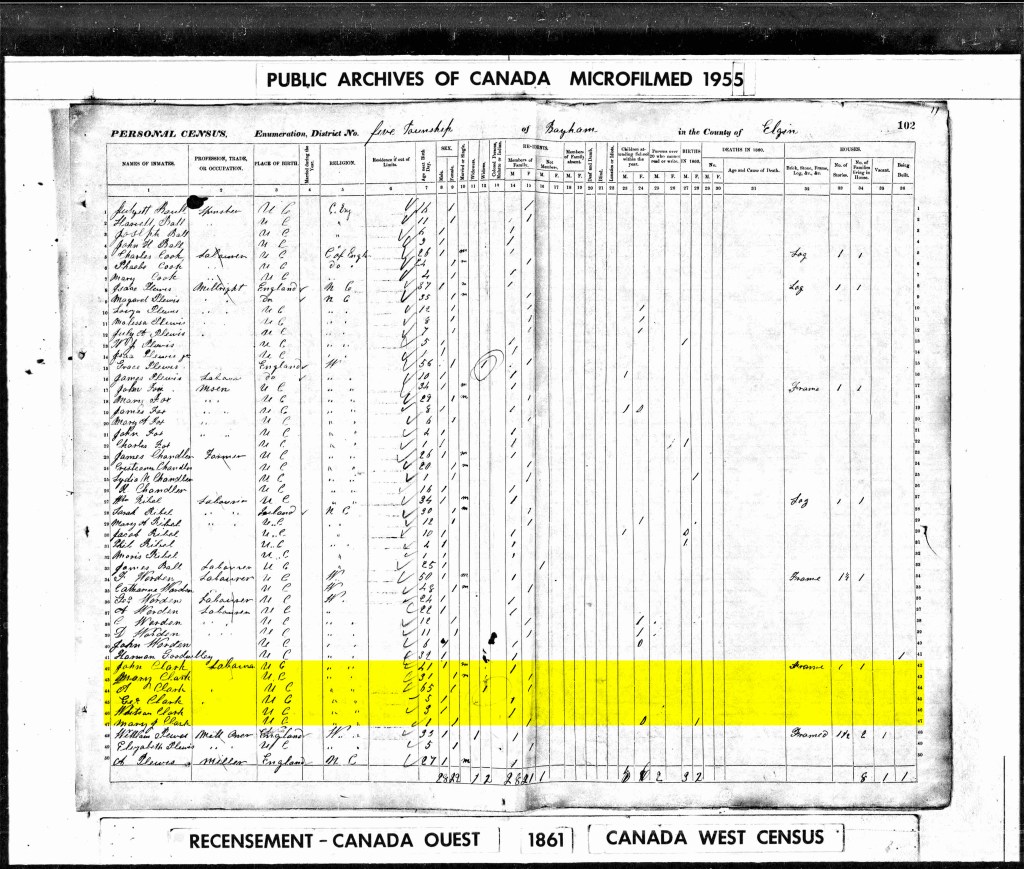
The 1861 census of Bayham Township, Elgin County, places John Clark, age forty-one, Mary Clark, age thirty-one, and an older “A. Clark,” age sixty-five, in the same household, along with George, William, and Mary J. Clark. This provides additional household evidence for identifying John Clark as another of Anna’s sons, although the census records only the older woman’s initial.37
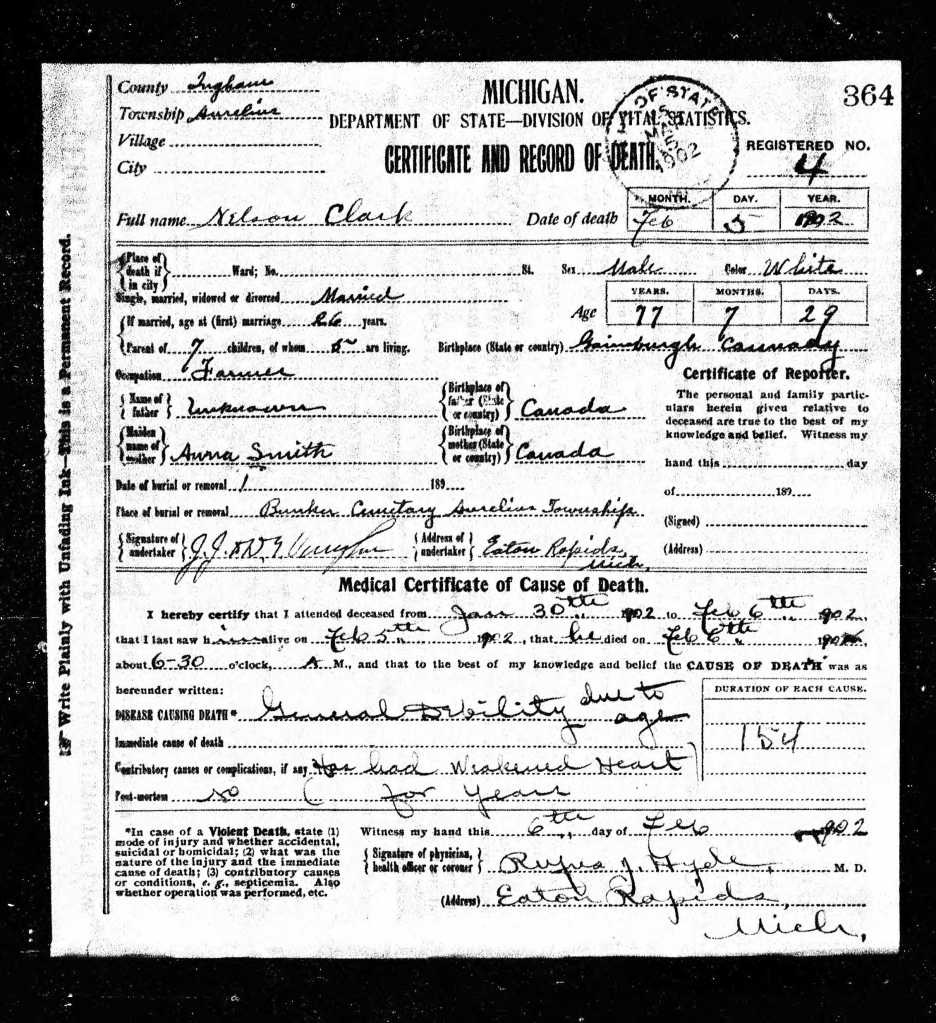
Nelson Clark’s later death certificate names Anna Smith as his mother and leaves his father unidentified, providing independent support for the identification of Anna Clark as Anna Smith. Taken together, these records make Anna a strong working identification as one of John Smith Jr.’s daughters and support the identification of three sons: John, Richard, and Nelson Clark.38
One additional possibility is worth preserving for future research: the 1851 Gainsborough census lists Christeen Clark, age twenty-two, in the household of Joseph Snyder. Her age is consistent with a possible daughter of Anna and George born about 1829, but no located record connects her directly to them.39
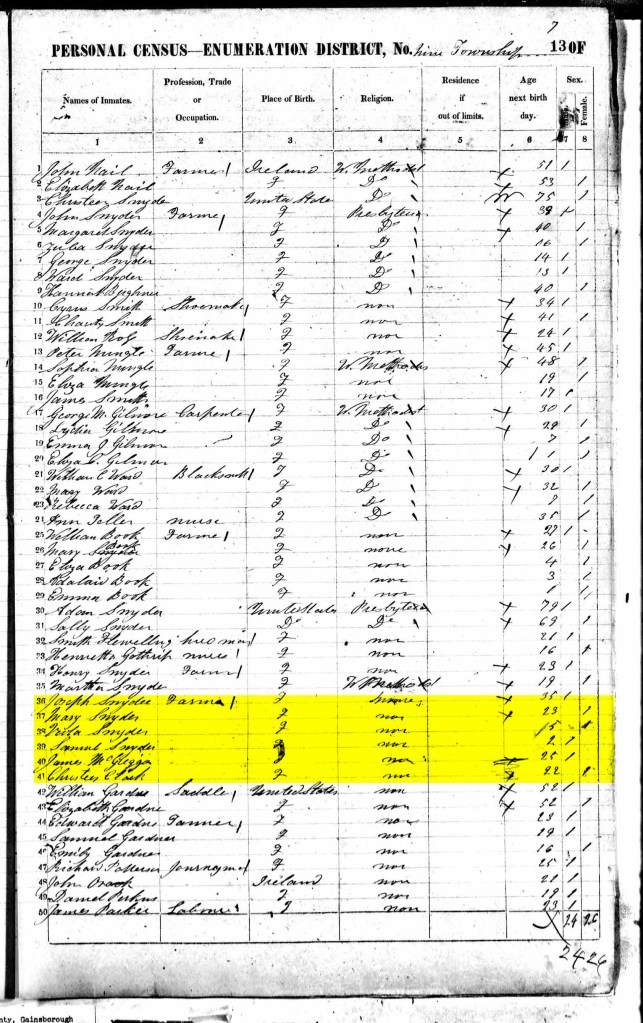
The Snyder household may also be relevant to the unexplained middle name Snyder in James Snyder Smith’s name, although there is presently no direct evidence that John Smith Jr.’s wife was a Snyder. This is a research lead, not an identified child.
Mary Smith
Mary Smith was born 2 October 1766 and died at the Town of Niagara, Canada West, on 11 June 1845. She was buried in St. Mark’s churchyard.40
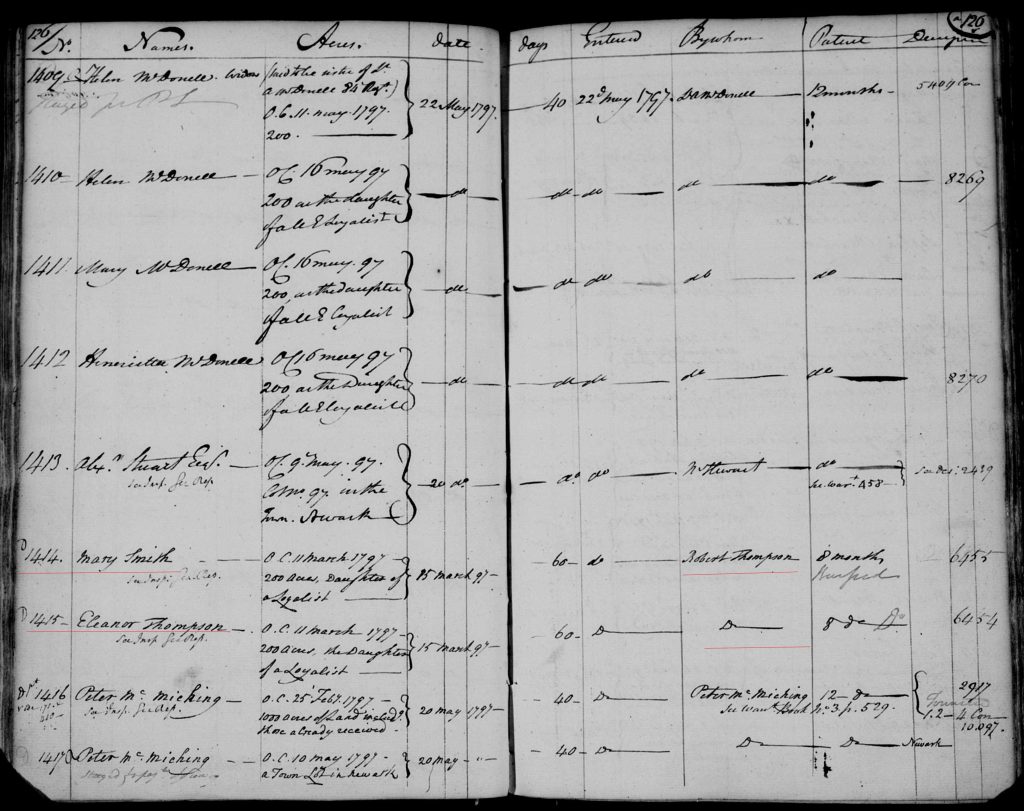
Mary was unmarried and thirty years old when she petitioned for land on 11 March 1797 as a daughter of John Smith, deceased, a U.E. Loyalist. Her petition register entry directly connects her application to her sister Eleanor’s household. Mary Smith and Eleanor Thompson appear consecutively in the register, and the “By Whom” column for Mary’s petition names Robert Thompson, Eleanor’s husband.41
Mary’s claim succeeded. On 30 June 1801 the Crown patented to her the whole of Lot 12 in the 14th Concession of Burford Township, containing two hundred acres. She retained the property throughout her life.42
Between 1801 and 1824 Mary married Alexander Gardner or Gardiner of Niagara, a native of Perthshire and master mason in the Royal Engineer Department.43 Alexander died in 1824 at age sixty-five.44 Mary survived him by twenty-one years and appears to have left no children.45
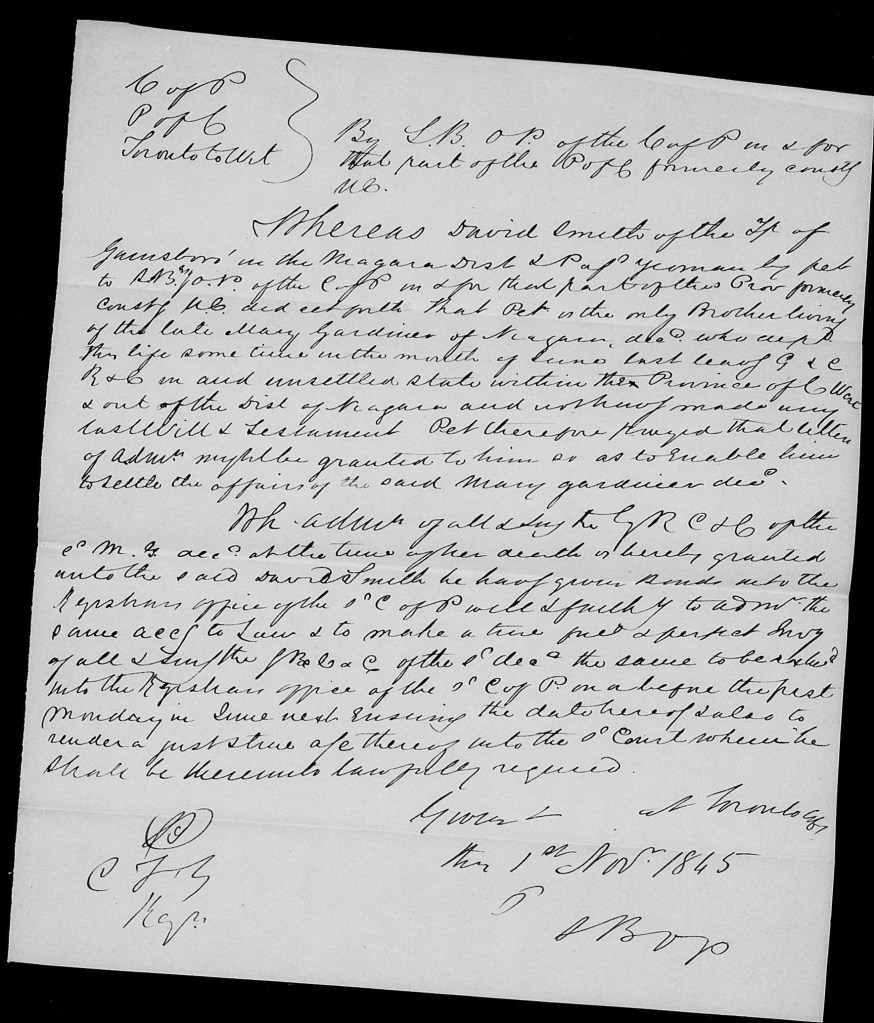
Mary died intestate with a substantial personal estate. On 1 November 1845 administration was granted to David Smith of Gainsborough, identified as her brother and only surviving brother.46
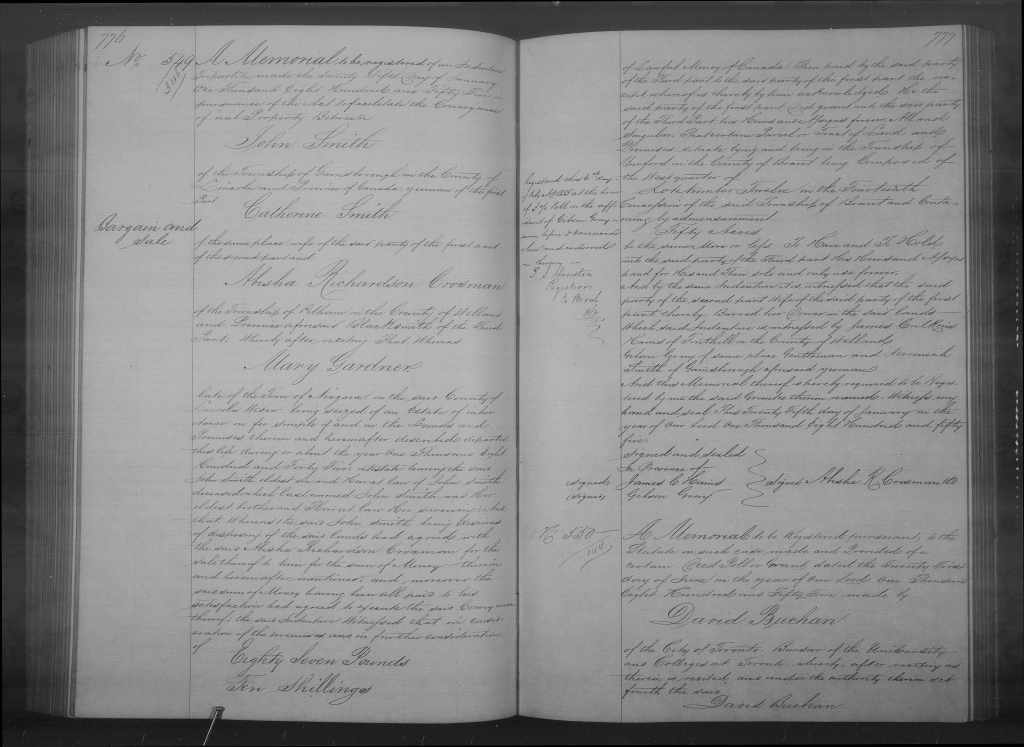
Her Burford land descended separately; the later memorials identify the deceased John Smith of Pelham Township as Mary’s eldest brother and John’s son John as his eldest son and heir at law.47
Elizabeth Smith
Elizabeth Smith was born about 14 April 1769 and died 23 January 1823.48 The date of birth is calculated from the age recorded in a gravestone inscription; the cemetery location has not been independently verified. She married Robert Camp, whose surname also appears as Kemp. They were in Upper Canada by 1792 with two children.49
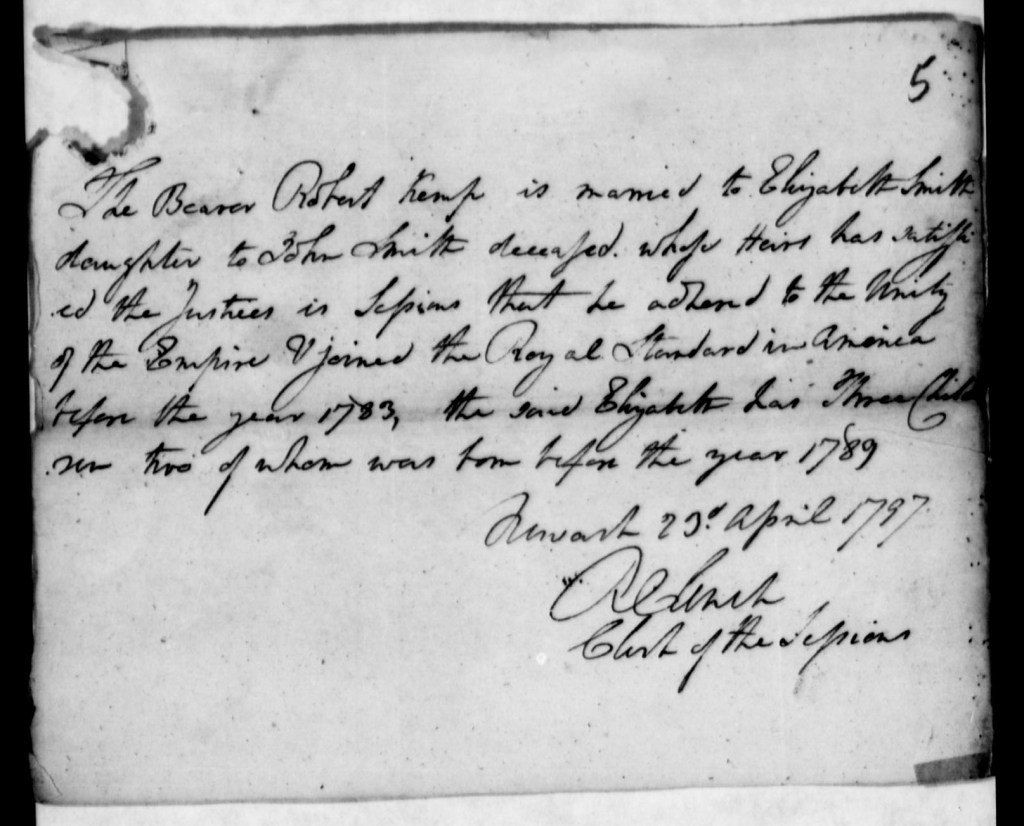
In a petition dated 25 April 1797, Robert Kemp petitioned for land on behalf of his wife, Elizabeth. He stated that he had come into Upper Canada in 1792 with a wife and two children, that he was married to Elizabeth, daughter of John Smith, a U.E. Loyalist, and that Elizabeth had never received land. He asked that she be granted 200 acres as the daughter of a Loyalist. The Clerk of the Sessions at Newark annexed a certificate to the petition describing Elizabeth as the daughter of John Smith, deceased, and stating that the justices were satisfied he had adhered to the Unity of the Empire and joined the Royal Standard in America before 1783. The certificate does not say where he died. It adds that Elizabeth then had three children, two of them born before 1789. The petition succeeded: a warrant for 200 acres was granted on 12 May 1797.50
David Smith
David Smith was born 14 March 1775 and died 29 August 1861 in Gainsborough Township, Lincoln County, Canada West.51
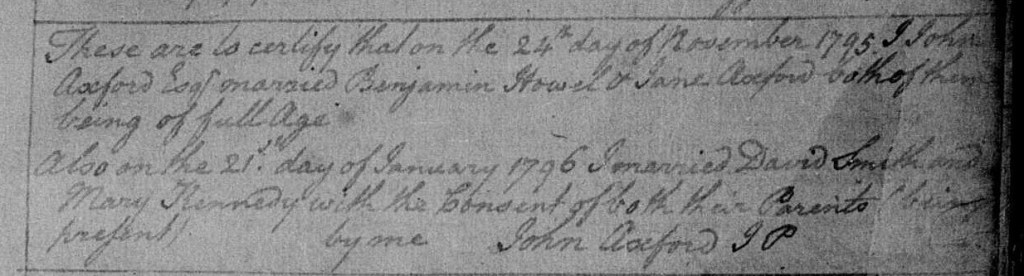
He married Mary Kennedy in Sussex County on 21 January 1796. The marriage entry states that they were married “with the Consent of both their Parents being present.” The wording indicates that a parent or surviving parent for each party was present and consented to the marriage, but it does not identify those parents. It therefore does not establish whether David’s father, John Smith Sr., was still living in January 1796.52
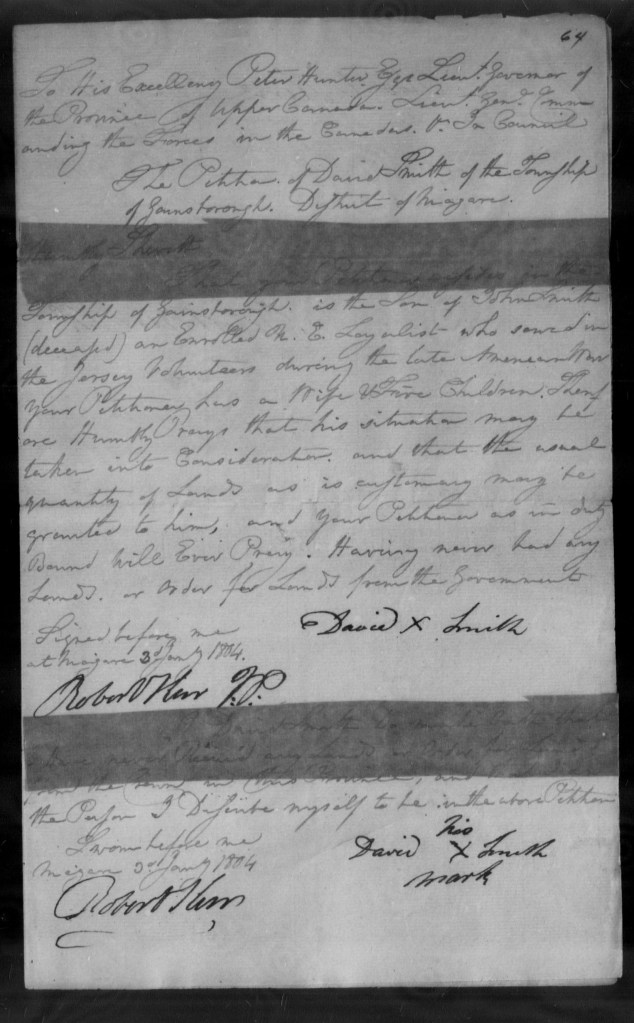
David later stated that he came from New Jersey to Upper Canada in 1800. In 1804 he petitioned for land as a son of John Smith, deceased, a U.E. Loyalist who served in the Jersey Volunteers. David was then living in Gainsborough with a wife and five children. His claim, like his brother John’s, was rejected as “Not Privileged.”53
David remained in Upper Canada. When Mary died in 1845, he was identified as her only surviving brother and served as administrator of her estate.
Cornelia Smith
Cornelia Smith was born about 177654 and died before 1819 in Upper Canada.55 She married William Shingler in Sussex County on 22 March 1798.56
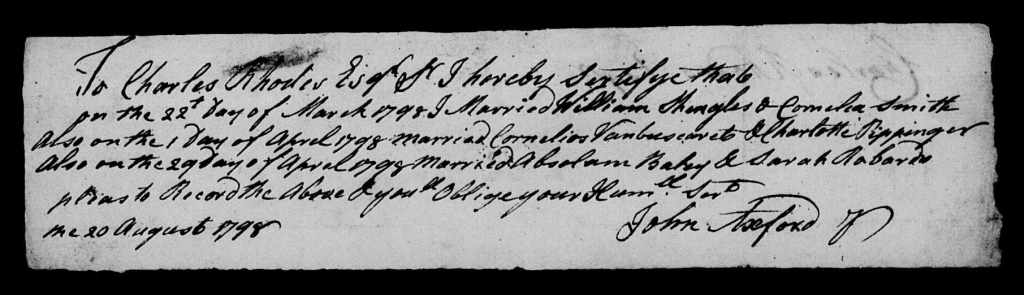
No land petition has yet been located for Cornelia or William, but later records preserve their connection to the Smith family. William Shingler witnessed an 1805 Gainsborough deed involving his brother-in-law John Smith, and John’s 1844 will refers to a mortgage involving William Shingler Jr. Cornelia’s 1798 marriage also shows that members of the family remained in Sussex County after other siblings had begun establishing themselves in Upper Canada.57
A later Michigan death record directly names Henry Shingler’s parents as William Shingler and Cornelia. Henry died in Genesee County, Michigan on 7 November 1870, aged 52 years, 11 months, and 21 days; that age calculates to a birth date of 16 November 1817. The record therefore provides direct evidence of at least one child of Cornelia and William and extends this Sussex County family into the next generation.58
A Family That Moved in Stages
The records do not describe a household that simply moved together after the Revolution. Instead, the family dispersed and gradually reassembled in British North America. Elizabeth and Robert Kemp were in Upper Canada by about 1792. Eleanor and Mary were there by the later 1790s. Cornelia was still in Sussex County where she married in 1798. David said that he moved from New Jersey in 1800. John arrived sometime before his 1804 petition.
Their father followed a different path. All three of the daughters’ 1797 applications describe him as deceased — Eleanor’s and Mary’s in March, and the certificate annexed to Elizabeth’s in April — but Eleanor’s is the only one that reports where he died. An addenda sheet for the Home District U.E. list contains the unusually specific entry “Smith. John who died at Brunswick” followed by “New Jersey 1777.” The entry does not explain the significance of the year 1777. Nevertheless, its combination of New Jersey and a death in New Brunswick agrees with what Eleanor’s petition reports.59
The Years Between 1783 and 1797
The surviving family records leave a significant gap in John Smith Sr.’s history. By 1797, his children described him as a Loyalist who had died in New Brunswick. They do not say when he arrived there, where he lived, what he did after the Revolution, or when he died. At present, his whereabouts between the end of the war in 1783 and the 1797 petitions remain unknown.60
One record may narrow the question, but only slightly. When David Smith married Mary Kennedy in 1796, the entry stated that “both their parents” were present and consenting.61 The wording indicates parental participation on both sides of the marriage, but it does not identify the parents who attended. Nor does it necessarily mean that all four biological parents were alive and present. The record therefore should not be treated as proof that David’s father, John Smith Sr., was still living in 1796. It could have been his mother.
The family’s report that John died in New Brunswick is historically plausible. At the end of the Revolution, British military units and Loyalist refugees were evacuated from New York to British North America. Thousands arrived in 1783 in what was then Nova Scotia, particularly along the Saint John River and the Bay of Fundy. Veterans of the New Jersey Volunteers were among the Loyalists who received land or settled in the region. New Brunswick was created as a separate province the following year.62
That larger migration explains how a Sussex County Loyalist might have reached New Brunswick, but it does not establish that John followed any particular regiment, transport, settlement party, or relative. Loyalists arrived as soldiers, discharged veterans, civilian refugees, dependents, laborers, and later migrants. Without a record naming this John Smith, the general history of the evacuation cannot fill the gap in his individual history.
Research in New Brunswick records has not yet produced a conclusive identification. The name John Smith appears repeatedly in Loyalist lists, land petitions, grants, military records, probate files, and local histories. Most of those occurrences contain too little identifying information to connect the man named with this family. A shared name, Loyalist status, or residence in New Brunswick is not enough, particularly when several unrelated men named John Smith were present in the province.
The New Brunswick search has not yet produced a document that connects any particular John Smith with the Sussex County associates, wife, children, occupation, or later Upper Canada family. Nor has a probate or land record been found that securely connects a New Brunswick John Smith with the children who later settled in Upper Canada. The search has therefore produced possibilities, but no identification strong enough to present as fact.63
For now, the defensible conclusion is limited: the family’s 1797 records identify John Smith Sr. as a Loyalist who served in the New Jersey Volunteers and report that he had died in New Brunswick. How and when he reached the province, where he settled, and what became of him between 1783 and 1797 remain unknown. The military evidence that may identify him before that gap requires a separate examination.
Notes
- Estimated birth, about 1730. This is a working estimate based on John Smith Sr.’s reported service in the New Jersey Volunteers and the age he would likely have been during the American Revolution. No record of his birth has been located. ↩
- Upper Canada Land Petitions, vol. 495, petition T2/52, Eleanor Smith Young Thompson, 3 March 1797, microfilm C-2833, Library and Archives Canada; digital image. The petition and supporting material identify John Smith as Eleanor’s father, a Loyalist associated with New Jersey who had died in New Brunswick. ↩
- Upper Canada Land Petitions for Eleanor Smith Young Thompson, John Smith Jr., Mary Smith, Elizabeth Smith Camp/Kemp, and David Smith; estate and land records for Mary Gardiner and John Smith; and related records cited in the notes that follow. Together, these records establish the reconstructed sibling group and its connections between New Jersey and Upper Canada. ↩
- David Young estate, inventory, 31 August 1780, Oxford Township, Sussex County, New Jersey, Sussex County Wills, 224s–333s, image 626, New Jersey, U.S., Wills and Probate Records, 1739–1991, database and images, Ancestry.com; digital image. David Smith and Mary Kennedy marriage return, 21 January 1796, Sussex County, New Jersey, performed by Justice John Axford; digital image, FamilySearch. William Shingler and Cornelia Smith marriage, 22 March 1798, Sussex County, New Jersey, “New Jersey, U.S., Marriage Records, 1670–1965,” database and images, Ancestry.com, subscription database. These records place the family in or near Oxford Township and show that David and Cornelia remained in Sussex County after other family members began moving to Upper Canada.↩
- Oxford Township tax ratables, Sussex County, New Jersey, July 1773, New Jersey State Archives, Tax Ratables SAS00001, Book 1801; digital image, New Jersey Department of State. Also available on Family History Library microfilm 865491, image group 7895283. ↩
- Estimated birth, about 1758. Eleanor was married to David Young by 1780, when his Oxford Township estate was inventoried, placing her marriage in the 1770s and her birth well before 1762. Her position before Mary (born 1766), Elizabeth (born 1769), David (born 1775), and Cornelia (born about 1776) supports an estimate in the later 1750s. No record of her birth has been located. ↩
- Upper Canada Land Petitions, vol. 495, petition T2/52, Eleanor Smith Young Thompson, 3 March 1797, microfilm C-2833, Library and Archives Canada; digital image. The petition describes Eleanor as formerly the wife of David Young and then the wife of Robert Thompson, establishing both marriages by March 1797. ↩
- David Young estate, inventory, 31 August 1780, Oxford Township, Sussex County, New Jersey, Sussex County Wills, 224s–333s, image 626, New Jersey, U.S., Wills and Probate Records, 1739–1991, database and images, Ancestry.com; digital image. The estate papers do not name children. ↩
- Upper Canada Land Petitions, vol. 495, petition T2/52, Eleanor Smith Young Thompson, 3 March 1797, microfilm C-2833, Library and Archives Canada; digital image. The petition identifies Eleanor as John Smith’s daughter and states that her father had joined the Royal Standard and died in New Brunswick. ↩
- The 1780 David Young estate papers do not name children; see note 8. The later identification of a David Young as a possible son of Eleanor and David is therefore tentative. A 4 September 1830 Pelham petition places a David Young within the Smith–Price network but does not identify his parents; digital image, FamilySearch. ↩
- Petition of inhabitants of Pelham Township in support of David Young, 4 September 1830, Upper Canada Land Petitions, RG 1, L 3, vol. 552, Library and Archives Canada; digital image, FamilySearch. The petition is signed by Joseph C. Price and John Smith, but does not identify David Young’s parents or establish which John Smith signed. ↩
- Robert Thompson, will dated 17 October 1822, and related memorial of exemplification registered 4 December 1834, Township of Niagara, Lincoln County, Upper Canada; will, digital image, and related memorial, digital image, FamilySearch. The will identifies Eleanor’s children but does not name Eleanor, supporting the conclusion that she had died before the will was made. ↩
- Robert Thompson, will dated 17 October 1822, Township of Niagara, Lincoln County, Upper Canada; digital image, FamilySearch. The will names James, John, Robert, Andrew Heron, Alexander Garner, Jane McClelland, and Ann. It mentions Catharine London in a provision allowing her and Ann to use a room while single, but does not clearly identify Catharine as Robert’s daughter. ↩
- Robert Thompson, will dated 17 October 1822, Township of Niagara, Lincoln County, Upper Canada; digital image, FamilySearch. The possibility that “Alexander Garner” honored Eleanor’s brother-in-law is an inference from Mary Smith’s later identification as Mary Garner/Gardiner and the memorial records for Mary Smith Garner and Alexander Gardiner. ↩
- Estimated birth, about 1760. John Smith Jr.’s death occurred between 22 August 1844, the date of his will, and 24 January 1845, when probate was granted at Niagara. Estate of John Smith, 1844, Lincoln County Surrogate Court Estate Files, 1794–1859, RG 22-235, Archives of Ontario; copy from microfilm purchased from the Archives of Ontario. The will opens, “I John Smith Senr Township of Pelham District of Niagara Province of Canada West,” and names his eldest son John. ↩
- John Smith, Upper Canada Land Petitions, vol. 453, petition S6/63, microfilm C-2809, Library and Archives Canada, petition dated 2 January 1804 and acted upon in March 1804; digital image. John stated that he had served in the Jersey Volunteers, that his deceased father John Smith was also a U.E. Loyalist who served in that corps, and that he had a wife and six children. ↩
- Estate of Mary Gardiner, 1845, Court of Probate, Canada West, RG 22 / 6-1-A / GARDINER, MARY 1845, Archives of Ontario; digital image, FamilySearch. See also Abstract Index to Deeds, Burford Township, Lot 12, Concession 14, Brant County Land Registry Office, and memorials nos. 10, 549, and 646, together with the abstract index image, FamilySearch. The related Estate of John Smith, 1844, RG 22-235, Archives of Ontario, is a copy from microfilm purchased from the Archives of Ontario. Together these records identify John Smith of Pelham Township as Mary’s deceased eldest brother and his son John as Mary’s nephew and heir at law. ↩
- Estate of John Smith, 1844, Lincoln County Surrogate Court Estate Files, 1794–1859, RG 22-235, Archives of Ontario; copy from microfilm purchased from the Archives of Ontario. The will styles the testator “John Smith Senr.” and names his eldest son John. The interpretation that this is compatible with an earlier “Junior” designation is genealogical analysis, not a statement made in the will. ↩
- John Smith, Upper Canada Land Petitions, vol. 453, petition S6/63, microfilm C-2809, Library and Archives Canada, petition dated 2 January 1804; digital image. The petition was rejected as “Not Privileged,” and the annotation states: “The Name John Smith of the Home District appears Three times on the U.E. List.” ↩
- Centennial of the Settlement of Upper Canada by the United Empire Loyalists, 1784–1884 (Toronto: Rose Publishing Company, 1885), Appendix B, p. 256; digital image, Google Books. The comparison table also uses the individual family and land records cited elsewhere in this post. ↩
- Centennial of the Settlement of Upper Canada by the United Empire Loyalists, 1784–1884, Appendix B, p. 256; digital image, Google Books. The entry reads “Smith, John . . . Who died at Brunswick,” with “New Jersey 1777.” The archival addendum is identified as RG 5, A 1, vol. 259, p. 140850, Library and Archives Canada; digital image, FamilySearch. The Brunswick entry is the best fit for the reconstructed Oxford/Sussex family because Eleanor’s 1797 petition reports that her father died in New Brunswick, while John Jr.’s 1804 petition identifies Jersey Volunteers service for both himself and his deceased father. See also Eleanor’s petition, Elizabeth’s petition, and John Jr.’s petition. ↩
- Centennial of the Settlement of Upper Canada by the United Empire Loyalists, 1784–1884, Appendix B, p. 256; digital image, Google Books; related petition abstracts, The Niagara Settlers. This John Smith, formerly of Dutchess County, New York, arrived in Upper Canada in 1786 with a wife and nine children. His large Grand River/Ancaster family is distinct from the reconstructed Oxford family, whose father was reported deceased by March 1797 and associated with New Brunswick. ↩
- Centennial of the Settlement of Upper Canada by the United Empire Loyalists, 1784–1884, Appendix B, p. 256; digital image, Google Books. The Niagara entry reports service in the 78th Regiment at Quebec and later the 84th Regiment. That regimental history differs from the Jersey Volunteers service reported for John Jr. and his father in the 1804 petition; John Jr.’s petition. ↩
- Centennial of the Settlement of Upper Canada by the United Empire Loyalists, 1784–1884, Appendix B, p. 256; digital image, Google Books. The Head of the Lake entry concerns the settler associated with Grimsby Lot 16, who reported arriving in 1788 and named sons Benjamin, Stephen, and John. Later accounts call him “Little John” and identify his wife as Anna Roy; see UELAC and R. Janet Powell, Annals of the Forty: Loyalist and Pioneer Families of West Lincoln, 1783–1833, no. 8, pp. 15–16, digital copy, FamilySearch Digital Library. His Canadian land history is distinct from the Oxford family, and the alleged Sussex County origin remains unproved. ↩
- Estate of John Smith, 1844, Lincoln County Surrogate Court Estate Files, 1794–1859, RG 22-235, Archives of Ontario; copy from microfilm purchased from the Archives of Ontario. The will names sons John and James. John’s 1804 petition states that he had a wife and six children. Mary and Anna are not directly identified as his daughters in the located records; their identifications are based on the cumulative evidence discussed in notes 26–39. ↩
- Price–Hutson Burial Ground, OGS no. 5750, Lot 256 BF, former Thorold Township, now Welland; transcription by Harold A. Fox, June 1983, Niagara Peninsula Branch, Ontario Genealogical Society, ISBN 978-0-7779-3772-3; cemetery index. The derivative transcription reads “PRICE, Joseph C 1783–1842 (wife Mary 1787–1862).” ↩
- Estimated marriage date, by about 1807, from the age of the eldest known son. John S. Price died 18 April 1860, aged 52, according to Fonthill Municipal Cemetery, Brown’s North, OGS no. 4631, Pelham Township, Welland County, p. 28. No record of Joseph C. Price and Mary Smith’s marriage has been located. ↩
- Will of Mary Price the elder, Fonthill, dated 25 December 1861 and proved 16 January 1862, Surrogate Court of Welland County, registered copy, pp. 390–393; digital image, FamilySearch. The probate recites that she died on or about 4 January 1862 and names her children, including David Smith Price, Mary Price the younger, and her deceased son John S. Price. ↩
- 1851 Census of Canada West, Lincoln County, Gainsborough Township, Schedule A, roll C_11736, p. 68, line 9, enumerator Jacob Kennedy: John Smith, cordwainer, and Catharine Smith; digital image, Ancestry. This is the John Smith and Catharine Smith household—not the James Smith/Ann Clark household cited in note 36 or the Christeen Clark household cited in note 39. Ages at next birthday were 58 and 52, supporting estimated births about 1794 and 1799. ↩
- Petition of Catharine Smith of Gainsborough Township, sworn 13 July 1819 in the General Quarter Sessions of the District of Niagara before Thomas Dickson; Upper Canada Land Petitions, “S” Bundle 12, 1819–1820, RG 1, L 3, vol. 460, p. 270, Library and Archives Canada; digital image. Catharine stated that she was married to John Smith of Gainsborough and was the daughter of John Schram of Pelham, establishing the marriage by July 1819. ↩
- Jeremiah Smith et al. to Joseph Smith, memorial no. 14229, indenture dated 2 December 1865 and registered 28 December 1865, Pelham Township, Welland County, book E, p. 18; digital image, FamilySearch. The memorial records John Smith the Elder’s death at Pelham on or about 9 January 1863, names his heirs, and identifies his widow Catharine. The identification of this man as John Smith Jr.’s eldest son rests on the chain of records linking Catharine of Gainsborough in 1819, the farm in John Jr.’s 1844 will, the 1851 Gainsborough household, and the Burford memorials. ↩
- 1851 Census of Canada West, Lincoln County, Gainsborough Township, personal census, p. 19: James Smith and William Smith, ages 56 and 12; digital image, Ancestry, subscription database. The relationship is not stated, so identifying William or Willson as James’s son remains tentative. ↩
- Estimated birth, about 1800. The 1851 Gainsborough census gives Anna’s age at next birthday as 43, while the 1861 Bayham census gives the older “A. Clark” an age of 65. Both identify her as Canadian-born. The estimate about 1800 best accommodates the age of her son John Clark and the family’s 1804 report of six children. No record of her birth has been located. ↩
- Estimated marriage and husband identification. John Clark’s age of 41 in 1861 places his birth about 1820, suggesting that Anna married by about 1819. No located record names Anna’s husband. “George Clark” is a working identification based on the reconstruction of the Thorold–Pelham Clark family, in which George is the otherwise unaccounted-for son most consistent with this marriage. ↩
- Joseph C. Price and John Smith, signatures on a 4 September 1830 Pelham petition concerning David Young; digital image, FamilySearch. See also the 25 April 1831 Pelham petition signed by both men, digital image. Mary Price the Elder’s 1862 probate identifies David Smith Price and Mary Price the younger as her children, digital image; an 1868 land record identifies John Smith Price as her son and names his siblings, digital image. These records establish the Price relationships but do not directly state that Mary Smith Price was John Smith Jr.’s daughter. ↩
- 1851 Census of Canada West, Lincoln County, Gainsborough Township, personal census, p. 19, lines 26–29: James Smith, born in the United States; Ann Clark, born in Canada; William Smith; and Richard Clark; digital image, Ancestry, subscription database. James is marked widowed and blind; Ann is marked single, although Richard Clark’s presence and the children’s ages make parts of the enumeration unreliable. The household composition and surnames support, but do not prove, the identification of James Snyder Smith and Anna Smith. ↩
- 1861 Census of Canada West, Elgin County, Bayham Township, enumeration district 5, p. 102: John Clark, age 41; Mary Clark, age 31; and an older “A. Clark,” age 65, with George, William, and Mary J. Clark; digital image, Ancestry, subscription database. The household provides additional evidence for identifying John Clark as one of Anna’s sons, but the older woman is recorded only by an initial and the relationships are not stated. ↩
- Nelson Clark, Michigan death certificate; digital image, Ancestry, subscription database. The certificate names Anna Smith as Nelson’s mother and leaves his father unidentified. In combination with the 1851 and 1861 census evidence, it supports Anna as a strong working identification among John Smith Jr.’s daughters and supports the identification of John, Richard, and Nelson Clark as her sons. ↩
- 1851 Census of Canada West, Lincoln County, Gainsborough Township, personal census, p. 130F: Christeen Clark, age 22, in the household of Joseph Snyder; digital image, Ancestry, subscription database. The census establishes Christeen’s age and household appearance but does not identify her parents or connect her directly to Anna Smith and George Clark. She is therefore a possible, unconfirmed child. ↩
- Gravestone of Mary Gardner, St. Mark’s Anglican Cemetery, Niagara-on-the-Lake, Ontario, read from a photograph; see also “Mary Smith Gardner,” memorial no. 233850644, Find a Grave. The inscription gives an age of 78 years, 8 months, and 9 days. Read with the 11 June 1845 death date recorded in the estate material, that age calculates to a birth date of 2 October 1766. ↩
- Mary Smith, Upper Canada Land Petitions, vol. 449, petition S2/141, microfilm C-2806, Library and Archives Canada, dated or received 11 March 1797; digital image. See also the Upper Canada land-petition register, entries D1414, Mary Smith, and D1415, Eleanor Thompson, RG 1, C-I-3, p. 120; digital image, FamilySearch. The register places the sisters’ petitions consecutively and names Robert Thompson in the “By Whom” column for Mary’s petition. ↩
- Crown patent to Mary Smith, 30 June 1801, Burford Township, Lot 12, Concession 14; Abstract Index to Deeds, Brant County Land Registry Office; digital image, FamilySearch. The index shows no conveyance by Mary during her lifetime. ↩
- The marriage record of Mary Smith and Alexander Gardner/Gardiner has not been located. The relationship rests on Mary’s identification as Gardiner in her 1845 estate, digital image, FamilySearch, and the memorial records for Mary Smith Garner and Alexander Gardiner. The surname appears as Garner, Gardner, and Gardiner in different records. ↩
- Gravestone of Alexander Gardiner, St. Mark’s Anglican Cemetery, Niagara-on-the-Lake, transcribed in Janet Carnochan, Graves and Inscriptions in the Niagara Peninsula, Niagara Historical Society; transcription published by the Niagara-on-the-Lake Museum. See also memorial no. 69780216, Find a Grave. The inscription describes Alexander as a native of Perthshire and a master mason in the Royal Engineer Department, and records his death in 1824 at age 65. ↩
- The conclusion that Mary left no children is inferential. Her 1845 intestate estate was administered by her brother David, and her Burford land descended to a nephew; see notes 46 and 47. No record naming a child of Mary and Alexander has been located. Alexander Gardiner memorial, Find a Grave. ↩
- Estate of Mary Gardiner, 1845, Court of Probate, Canada West, RG 22 / 6-1-A / GARDINER, MARY 1845, Archives of Ontario; digital image, FamilySearch. Administration was granted to David Smith of Gainsborough, identified as Mary’s brother and only surviving brother. ↩
- Burford Township memorials nos. 10, 549, and 646, registered 1853–1855, and the Abstract Index to Deeds, Burford Township, Lot 12, Concession 14, Brant County Land Registry Office. The memorials identify John Smith of Pelham Township as Mary’s deceased eldest brother and his son John as her nephew and heir at law. ↩
- Elizabeth Camp, Canadian Headstones, person record 452991; record and inscription. The inscription gives her death as 23 January 1823 and her age as 53 years, 9 months, and 9 days, calculating to an approximate birth date of 14 April 1769. The cemetery location has not been independently verified. ↩
- Robert Kemp/Camp, petition for his wife Elizabeth, 25 April 1797, Newark, Upper Canada Land Petitions, RG 1, L 3, vol. 268, bundle K 3, petition 5, microfilm C-2116, Library and Archives Canada; digital image. Robert stated that he had come into the province in 1792 with a wife and two children and was married to Elizabeth. He signed “Robert Camp”; the docket and certificate spell the surname Kemp. ↩
- Robert Kemp/Camp, petition dated 25 April 1797, Newark, Upper Canada Land Petitions, RG 1, L 3, vol. 268, bundle K 3, petition 5, microfilm C-2116, Library and Archives Canada; digital image. The petition identifies Elizabeth as the daughter of John Smith, deceased, and the certificate states that the justices were satisfied John had adhered to the Unity of the Empire and joined the Royal Standard before 1783. The warrant for 200 acres was granted 12 May 1797. ↩
- David Smith, CanadaGenWeb Cemetery Project, person record 2358233; record. The record reports David’s birth on 14 March 1775 and death on 29 August 1861 in Gainsborough Township, Lincoln County, Canada West. ↩
- Sussex County marriage return, David Smith and Mary Kennedy, 21 January 1796, performed by Justice John Axford; digital image, FamilySearch. The entry states that the marriage took place “with the consent of both their Parents being present.” ↩
- David Smith, Upper Canada Land Petitions, vol. 453, petition S6/64, microfilm C-2809, and vol. 462, petition S14/20, microfilm C-2814, Library and Archives Canada; digital image. The later petition states that David came from New Jersey to Upper Canada in 1800. ↩
- Estimated birth, about 1776. Cornelia married on 22 March 1798 and appears at the end of the sibling sequence after Mary (born 1766), Elizabeth (born 1769), and David (born 1775). No record of her birth has been located. ↩
- William D. Reid, The Loyalists in Ontario: The Sons and Daughters of the American Loyalists of Upper Canada (Lambertville, N.J.: Hunterdon House, 1973), p. 67; digital image, Ancestry. Reid abstracts an Order in Council of 27 January 1819 under Walter Clendenning: “Rebecca, m. —- Shingler. O.C. 27 Jan 1819.” The later land records identify the unnamed Shingler as William Shingler: Crown patent to Rebecca Shingler for Lot 22, Concession 2, Erin Township, 2 May 1837; deed dated 28 February 1838 and registered 3 March 1838, memorial no. 87, book L; abstract index and registered memorial, FamilySearch. These records show that William’s marriage to Rebecca Clendenning occurred by January 1819, so Cornelia had died by then. ↩
- William Shingler and Cornelia Smith marriage, 22 March 1798, Sussex County, New Jersey, “New Jersey, U.S., Marriage Records, 1670–1965,” database and images, Ancestry.com, subscription database. ↩
- Patrick McGaw and Hannah McGaw to John Smith, deed no. 5569, 23 December 1805, Gainsborough Township, Lincoln County, Upper Canada, land records, vols. G–H; digital image, FamilySearch. See also Estate of John Smith, 1844, RG 22-235, Archives of Ontario, which refers to a 3 November 1843 mortgage from William Shingler Jr. to John Smith’s son James. ↩
- State of Michigan, Genesee County, record of deaths, p. 39, entry no. 1775, Henry Shingler, 7 November 1870; digital image, FamilySearch. The record gives Henry’s age as 52 years, 11 months, and 21 days and names his parents as William Shingler and Cornelia. ↩
- Addenda to the Home District U.E. List, entry “Smith. John who died at Brunswick / New Jersey 1777,” RG 5, A 1, vol. 259, p. 140850, Library and Archives Canada; digital image, FamilySearch. The entry also appears in Centennial of the Settlement of Upper Canada by the United Empire Loyalists, 1784–1884, Appendix B, p. 256; digital image, Google Books. ↩
- Upper Canada Land Petitions of Eleanor Smith Young Thompson, 3 March 1797; Mary Smith, dated or received 11 March 1797; and Robert Kemp on behalf of Elizabeth Smith Kemp, 25 April 1797, Library and Archives Canada. These records report John Smith as deceased by the time of the petitions but do not establish the date, place, or circumstances of his death. ↩
- Sussex County marriage return, David Smith and Mary Kennedy, 21 January 1796, performed by Justice John Axford; digital image, FamilySearch. The entry does not name the parents who were present and therefore does not establish that David’s father was living on that date. ↩
- Government of New Brunswick, “History,” describing the arrival of Loyalist refugees at the mouth of the Saint John River beginning in 1783 and the creation of New Brunswick as a separate province in 1784, Government of New Brunswick; and “New Brunswick: Our Stories, Our People—1783,” describing the evacuation from New York and the arrival of Loyalist refugees in the Saint John River valley, Government of New Brunswick. These sources establish the historical setting, not John Smith’s individual route or settlement. ↩
- Research in New Brunswick records has located several men named John Smith but no record containing enough identifying information—such as Sussex County origin, named family members, occupation, associates, or a later Upper Canada connection—to identify one as the father of Eleanor, John, Mary, Elizabeth, David, and Cornelia Smith. This is a statement of the present research result, not proof that no identifying record survives. ↩

 Lives and Histories